
The AI Act: A Comprehensive Guide for 2026
The European Union's Artificial Intelligence Act represents the world's first comprehensive legal framework for regulating artificial intelligence systems. Entering into force in 2024 and reaching full application by 2026, the AI Act establishes clear rules that organisations must follow when developing, deploying, or using AI technologies. This legislation affects businesses across all sectors, from healthcare and finance to manufacturing and public services, creating obligations that extend far beyond European borders through its extraterritorial reach.
Understanding the AI Act's Risk-Based Framework
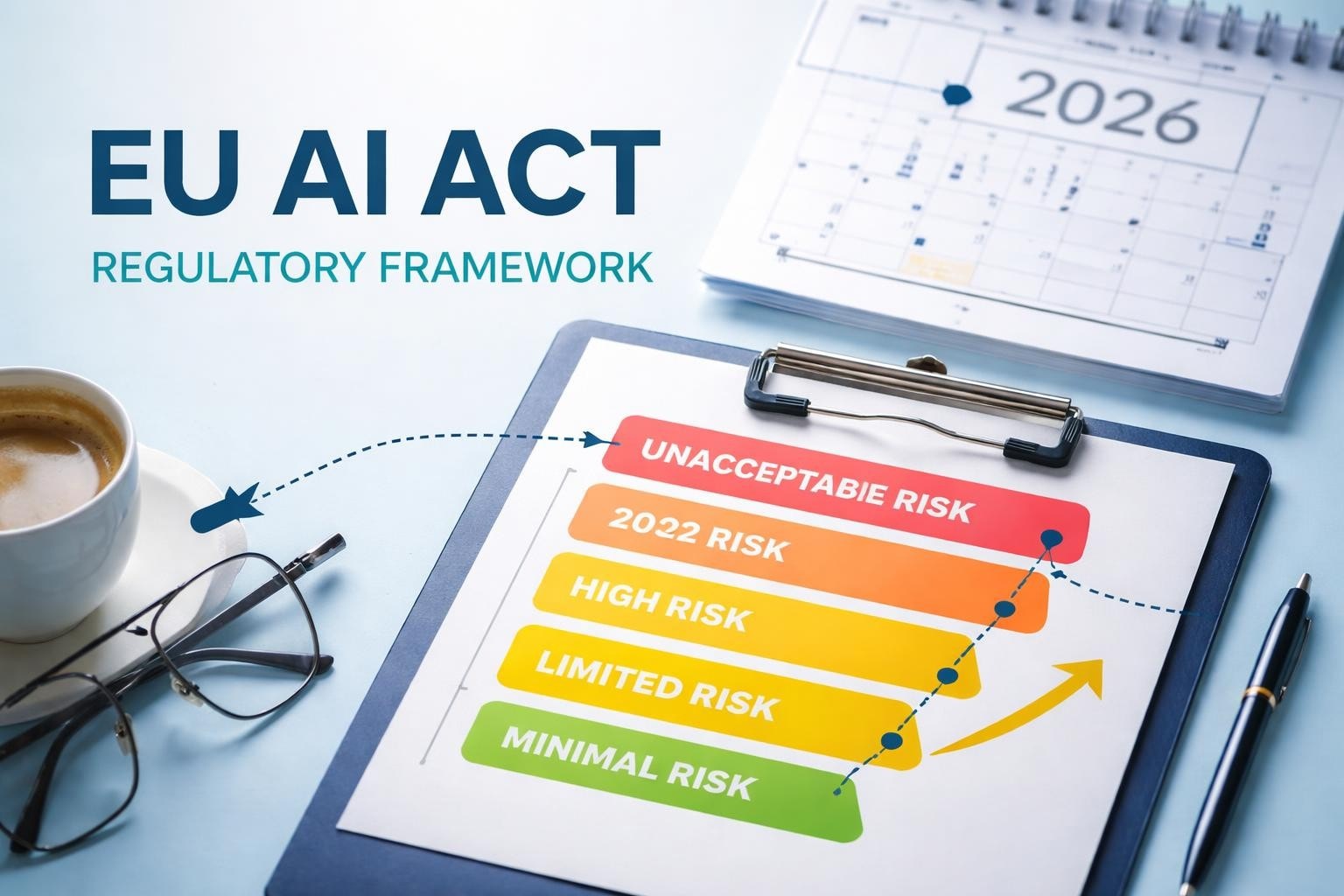
The AI Act categorises artificial intelligence systems according to the level of risk they pose to fundamental rights, safety, and societal values. This risk-based approach determines the regulatory requirements each AI system must meet.
The Four Risk Categories
The legislation divides AI systems into four distinct classifications, each with corresponding obligations:
Unacceptable Risk: These AI applications are prohibited entirely. The AI Act bans systems that manipulate human behaviour through subliminal techniques, exploit vulnerabilities of specific groups, enable social scoring by public authorities, or deploy real-time biometric identification in public spaces (with limited exceptions for law enforcement).
High Risk: These systems face stringent regulatory requirements. High-risk AI includes applications in critical infrastructure, educational access, employment decisions, essential services, law enforcement, migration management, and justice administration. The Atlantic Council highlights that this category creates significant compliance burdens for global companies.
Limited Risk: Systems such as chatbots and deepfake generators must meet transparency obligations. Users must be informed when they're interacting with AI or viewing AI-generated content.
Minimal Risk: The majority of AI systems fall into this category and face no specific obligations beyond general consumer protection laws. Examples include AI-powered spam filters and video games.
Compliance Requirements for High-Risk AI Systems
Organisations deploying high-risk AI systems must navigate extensive regulatory obligations that affect every stage of the AI lifecycle.
Technical Documentation and Risk Management
Providers must establish and maintain comprehensive technical documentation demonstrating compliance with the AI Act. This includes:
Detailed descriptions of the AI system's design and development process
Risk management procedures identifying and mitigating potential harms
Data governance protocols ensuring training data quality and relevance
Performance metrics and accuracy thresholds
Testing and validation procedures
The Deloitte analysis emphasizes that these requirements demand significant investment in documentation infrastructure and governance processes.
Compliance Area | Key Requirements | Timeline |
Risk Management | Continuous identification, assessment, and mitigation | Ongoing |
Data Governance | Quality standards, bias testing, data provenance | Before deployment |
Human Oversight | Meaningful human control mechanisms | Design phase |
Transparency | Clear information to users and deployers | Pre-deployment |
Record-Keeping | Automatic logging of events and decisions | Throughout operation |
Article 4 and Staff Training Requirements
Article 4 of the EU AI Act establishes crucial obligations for AI literacy among personnel involved with AI systems. This provision requires organisations to ensure their staff possess adequate understanding of AI capabilities, limitations, and risks.
Training programmes must cover:
Fundamental AI concepts and operational principles
Specific risks associated with the AI systems in use
Interpretation of AI outputs and decision-making processes
Recognition of system limitations and potential biases
Human oversight responsibilities and intervention procedures
Organisations seeking comprehensive compliance with these training obligations can explore AI Literacy Course for EU AI Act Compliance, which offers structured programmes aligned with Article 4 requirements across multiple enterprise sizes.
Timeline and Phased Implementation
The AI Act follows a staggered implementation schedule, with different provisions taking effect at various dates throughout 2025 and 2026.
Implementation Milestones
February 2025: Prohibitions on unacceptable risk AI systems become enforceable. Organisations must cease using banned applications immediately or face significant penalties.
August 2025: Requirements for general-purpose AI models take effect. Providers of foundation models must demonstrate compliance with transparency obligations and systemic risk assessments.
August 2026: Full application of the AI Act begins. All provisions, including those for high-risk AI systems, become legally binding across the European Union.
This phased approach provides organisations with time to assess their AI systems, implement necessary changes, and establish compliance frameworks. However, Oliver Wyman warns that delayed preparation increases both costs and compliance risks.
Global Impact and Extraterritorial Reach
The AI Act's influence extends well beyond European borders, affecting organisations worldwide that offer AI systems or services within the EU market.
The Brussels Effect in AI Regulation
Similar to the General Data Protection Regulation (GDPR), the AI Act creates a "Brussels Effect" where European standards influence global practices. Non-European companies must comply if they:
Provide AI systems or outputs used within the EU
Deploy AI systems affecting individuals located in the EU
Operate as providers or deployers with EU establishments
Research from Brookings Institution suggests that whilst the AI Act will shape international AI governance, its global harmonisation effects may be more limited than GDPR's due to competing regulatory approaches in other jurisdictions.
Implications for International Organisations
Companies based outside Europe face strategic decisions about AI compliance:
Market Access: Non-compliance restricts access to the lucrative European market, home to over 450 million consumers and sophisticated business customers.
Competitive Advantage: Early compliance can differentiate organisations as trustworthy AI providers, particularly as other jurisdictions develop similar frameworks.
Operational Complexity: Maintaining separate AI systems for different markets increases costs and complexity, often making global compliance more economical.
The comprehensive training resources available through GURO's AI literacy programmes support international teams in understanding and implementing the AI Act's requirements regardless of their location.
Governance Structures and Enforcement Mechanisms
The AI Act establishes a multi-layered governance framework combining European-level coordination with national enforcement authorities.
European AI Office and AI Board
The European AI Office serves as the central coordinating body, supporting consistent application of the AI Act across member states. This office oversees general-purpose AI models, manages the regulatory sandbox programme, and facilitates cooperation between national authorities.
The AI Board comprises representatives from all EU member states, providing advice on implementation, promoting best practices, and ensuring harmonised enforcement approaches.
National Competent Authorities
Each member state designates national competent authorities responsible for:
Supervising AI systems within their jurisdiction
Investigating potential non-compliance
Imposing administrative fines and corrective measures
Issuing guidance for specific sectors or applications
Coordinating with other national authorities on cross-border issues
This decentralised enforcement model mirrors GDPR's structure but introduces challenges around consistent interpretation and application across 27 different legal systems.
Penalties and Non-Compliance Consequences
The AI Act imposes substantial financial penalties for violations, calculated as a percentage of global annual turnover or fixed amounts, whichever is higher.
Fine Structure
Violation Type | Maximum Fine (% of Global Turnover) | Maximum Fine (Fixed Amount) |
Prohibited AI practices | 7% | €35 million |
Non-compliance with AI system requirements | 3% | €15 million |
Incorrect, incomplete, or misleading information | 1.5% | €7.5 million |
These penalties apply to the organisation's worldwide annual turnover from the preceding financial year, creating significant financial exposure for large enterprises. Perforce's analysis emphasises that compliance challenges around enterprise data management can inadvertently lead to violations carrying these severe penalties.
Beyond financial consequences, non-compliance damages reputation, erodes customer trust, and may result in operational restrictions or bans on specific AI systems.
Sector-Specific Implications
Different industries face unique challenges and opportunities under the AI Act, with varying levels of regulatory scrutiny and compliance complexity.
Healthcare and Medical Devices
AI systems used in healthcare frequently qualify as high-risk under the AI Act. Nature's research explores how the legislation affects regulated digital medical products, creating overlap with existing medical device regulations.
Healthcare organisations must address:
Clinical validation requirements for diagnostic AI
Patient safety considerations and adverse event reporting
Integration with medical device regulation frameworks
Explainability requirements for clinical decision support
Data protection obligations under GDPR
Financial Services
Banks, insurers, and financial technology companies deploy AI extensively for credit scoring, fraud detection, and investment advice. Many of these applications qualify as high-risk, particularly those affecting access to essential services or making significant decisions about individuals.
Financial sector compliance involves:
Algorithmic fairness in lending and insurance decisions
Transparency requirements for automated credit assessments
Human oversight of AI-driven financial recommendations
Bias testing and mitigation in risk models
Integration with existing financial regulation
Employment and Human Resources
AI systems influencing recruitment, performance evaluation, or employment termination decisions fall under high-risk classification. This creates obligations for:
Recruitment software providers and users
Performance monitoring systems
Automated CV screening tools
Workplace surveillance technologies
Task allocation algorithms
Organisations must ensure these systems don't perpetuate discrimination, maintain human oversight, and provide transparency to affected workers.
Preparing for Compliance in 2026
With full application approaching in August 2026, organisations must take immediate action to assess their AI landscape and implement necessary compliance measures.
Conducting AI System Inventories
The first step involves comprehensive mapping of all AI systems within the organisation:
Identify every AI application, from customer-facing chatbots to internal analytics tools
Classify systems according to the AI Act's risk categories
Determine provider and deployer roles for each system
Document the purpose, functionality, and data sources of each application
Assess current compliance gaps against AI Act requirements
Building Compliance Frameworks
Effective compliance requires integrated governance structures spanning multiple organisational functions:
Legal and Compliance Teams: Interpret requirements, assess regulatory risk, and establish policies aligned with the AI Act.
Technical Teams: Implement required technical measures, documentation practices, and testing procedures for AI systems.
Business Units: Understand how the AI Act affects their operations, products, and services whilst maintaining business objectives.
Human Resources: Develop and deliver AI literacy training programmes meeting Article 4 obligations, ensuring all staff working with AI systems possess adequate competence.
Organisations can explore detailed guidance on Article 4 compliance to understand specific training requirements for different roles and contexts.
The Role of Regulatory Sandboxes and Innovation
The AI Act establishes regulatory sandboxes where organisations can test innovative AI systems under controlled conditions with regulatory supervision. These sandboxes aim to balance innovation with safety and compliance.
Benefits of Regulatory Sandboxes
Participation in regulatory sandboxes offers several advantages:
Testing innovative AI applications before full market deployment
Receiving guidance from competent authorities during development
Demonstrating compliance in novel use cases
Reducing time-to-market for innovative solutions
Building regulatory relationships and trust
Member states must establish at least one regulatory sandbox, with coordination through the European AI Office ensuring consistent approaches across jurisdictions.
Fostering Responsible Innovation
Beyond sandboxes, the AI Act encourages organisations to adopt codes of conduct, harmonised standards, and best practices. Voluntary compliance mechanisms help demonstrate commitment to responsible AI development whilst potentially reducing regulatory scrutiny.
Codes of Practice and Industry Standards
The European Commission released a voluntary code of practice in early 2026, as reported by AP News, helping businesses understand transparency and safety obligations under the AI Act.
Key Elements of Voluntary Compliance
Industry-developed codes of practice address:
Technical specifications beyond minimum legal requirements
Sector-specific risk assessment methodologies
Shared approaches to testing and validation
Transparency mechanisms for AI outputs
Ethical considerations in AI development
Organisations adhering to recognised codes of practice demonstrate commitment to responsible AI whilst potentially benefiting from streamlined compliance processes.
Harmonised Standards
European standardisation bodies develop harmonised standards supporting AI Act compliance. Systems conforming to these standards benefit from a presumption of conformity with corresponding legal requirements, simplifying the compliance demonstration process.
Looking Ahead: AI Regulation Beyond Europe
The AI Act establishes a precedent that other jurisdictions are observing closely. Understanding the global regulatory landscape helps organisations anticipate future requirements and build adaptable compliance frameworks.
International Regulatory Developments
United States: Federal and state-level AI regulations are emerging, with sector-specific approaches in healthcare, finance, and employment. The fragmented U.S. approach contrasts with Europe's comprehensive framework.
United Kingdom: Post-Brexit UK is developing a principles-based regulatory approach, emphasising flexibility and sectoral expertise over prescriptive rules.
China: Chinese AI regulations focus on algorithmic recommendations, deepfakes, and generative AI, with distinct priorities around social stability and content control.
International Coordination: Efforts through the OECD, G7, and bilateral agreements aim to harmonise AI governance principles, though significant divergence remains in implementation approaches.
Addressing Uncertainty Through Regulatory Learning
Despite the AI Act's comprehensive scope, significant uncertainties remain about interpretation and application. Academic research mapping the regulatory learning space highlights areas requiring ongoing clarification and adaptation.
Common Compliance Challenges
Organisations face questions around:
Precise boundaries between risk categories for borderline systems
Application of proportionality principles in compliance measures
Integration with existing sectoral regulations
Assessment of indirect effects on fundamental rights
Evolution of requirements as AI technology advances
Addressing these uncertainties requires active engagement with regulatory authorities, participation in industry forums, and investment in compliance expertise.
The AI Act fundamentally reshapes how organisations develop, deploy, and govern artificial intelligence systems across Europe and beyond. Success in this new regulatory landscape demands comprehensive understanding, strategic planning, and ongoing commitment to responsible AI practices. GURO (myaitraining.eu) provides AI literacy training fully aligned with Article 4 requirements, ensuring your teams possess the essential knowledge needed for compliance whilst building practical AI competence across your organisation in over 30 languages.


Comments